
Bryson DeChambeau has arrived at Shinnecock Hills with another major-week equipment story.
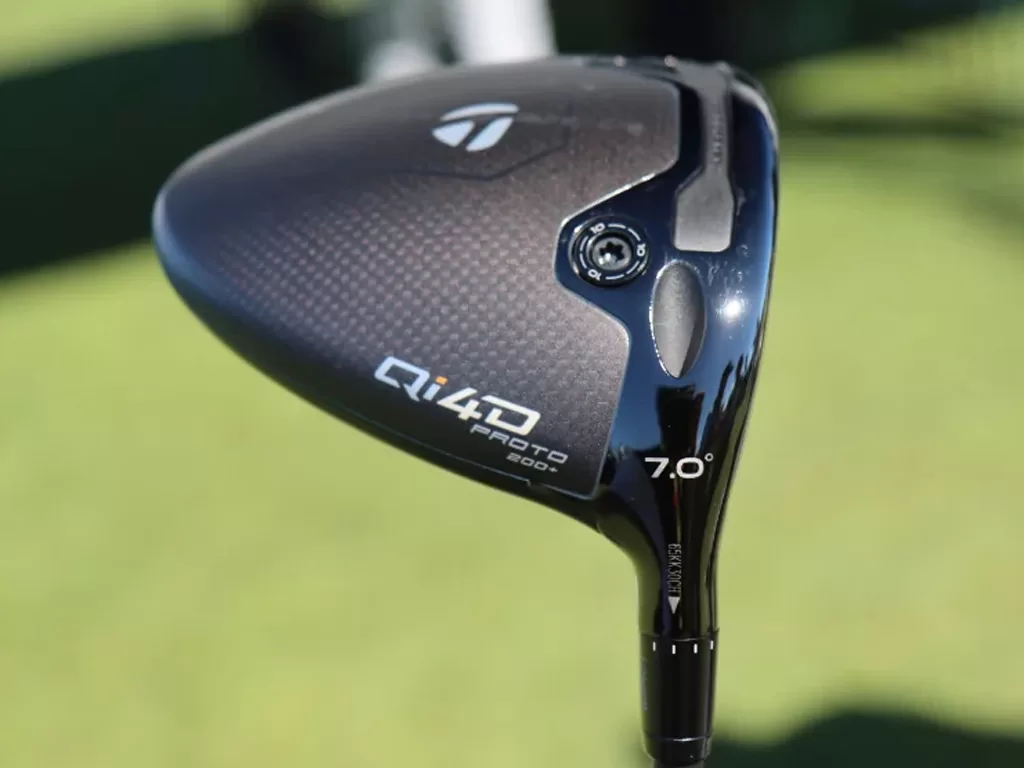
Ahead of the 2026 U.S. Open, the two-time champion has been testing a previously unseen TaylorMade driver called the Qi4D Proto 200+. It appeared on the USGA conforming list on Monday 15 June before being spotted in DeChambeau’s hands during practice.
The important word is still testing. DeChambeau has not committed publicly to using it in competition, and a few practice-ground swings do not guarantee that it will make the first tee on Thursday.
This is not a normal TaylorMade driver with Bryson’s preferred shaft. It appears to have been built around his speed and impact conditions.
What is the TaylorMade Qi4D Proto 200+?
The Qi4D Proto 200+ is a conforming TaylorMade prototype rather than a current retail model.
The USGA list contains two versions, both submitted at 7° of loft. Both feature a carbon face, TaylorMade’s Speed Pocket and an adjustable hosel, but the sole-weight layouts are different. Version 1 has three weight ports, while Version 2 has two.
Reports from Shinnecock suggest DeChambeau has been testing the two-weight version, with weights positioned towards the heel and toe. The head has also been paired with a Project X Titan Black 70 TX shaft during testing. (GolfWRX)
Confirmed details
TaylorMade Qi4D Proto 200+ head
Two versions on the USGA conforming list
7° stated loft
Carbon face
Adjustable hosel
Different sole-weight configurations
Project X Titan Black 70 TX shaft seen during testing
There is no full public specification sheet, retail release date or confirmation that the club will ever be sold.
Why is the driver only 7°?
Seven degrees sounds extremely low because it is.
Most amateur golfers use drivers somewhere around 9° to 12°. DeChambeau operates in completely different launch conditions, with enough speed and upward delivery to produce height without needing much static loft.
His previous Krank Formula Fire Pro driver was listed at 6°, so the TaylorMade prototype is not a sudden move towards an unusually low-lofted setup. It is actually close to what he was already playing. (GolfDigest.com)
Low loft can help a player with DeChambeau’s speed manage launch and spin. It can also make a driver less forgiving for somebody who does not deliver the club consistently.
For an ordinary golfer, copying the loft would probably produce low launches, poor carry and worse misses. The interesting part is not the number itself. It is how precisely the entire head appears to have been built around one player.
What does “200+” mean?
TaylorMade has not publicly explained the name.
The obvious theory is that 200+ refers to ball speed. DeChambeau has exceeded 200mph during speed training and long-drive competition, so the label would make sense for a prototype intended to survive and perform under those impact conditions.
That remains an informed assumption rather than a confirmed TaylorMade explanation. (Golf Monthly)
It may also distinguish the head from TaylorMade’s standard Qi4D range. This does not appear to be a normal production driver with less loft stamped on the sole.
The face curvature may be the real story
The most interesting detail is not the loft or the branding. It is the shape of the face.
Images of the prototype appear to show more face curvature than a standard Qi4D driver. That curvature is known as bulge and roll.
Bulge is the horizontal curve across the face. Roll is the vertical curve from crown to sole.
That shaping influences how the ball reacts when contact moves away from the centre. On a toe or heel strike, the curved face and the clubhead’s rotation can help alter the starting direction and spin axis.
DeChambeau has previously argued that higher-speed players need different face curvature because their misses become more severe at extreme ball speeds. A small difference in strike or face angle can send the ball much further offline when it is leaving the face at close to 200mph.
The prototype appears to continue that thinking. DeChambeau said he had been working on something capable of producing more speed while retaining the curvature that helps him control direction. (GolfWRX)
“If it works, it works. If it doesn’t, we’re going to keep trying.” (GolfWRX)
That is probably the clearest way to view this club. It is an experiment built around speed without giving up the directional help he believes the curved face provides.
Why move away from the Krank driver?
DeChambeau has been using a Krank Formula Fire Pro driver at 6°, including during the earlier part of the 2026 season. (Krank Golf)
The Krank head suited his unusual requirements. It offered very low loft and was connected to the high-speed equipment work he had carried out over several seasons.
The new TaylorMade does not necessarily mean the Krank was failing. Tour players test equipment constantly, and DeChambeau is more willing than most to explore a different solution.
The TaylorMade prototype appears to offer the same broad ingredients he values:
Very low loft
A head prepared for extreme speed
Significant face curvature
Adjustable weight positioning
A heavy, extremely stiff shaft
A shape intended to keep aerodynamic drag down
The potential gain is not simply more distance. DeChambeau already has enough of that.
The useful gain would be maintaining his speed while narrowing the pattern of his misses.
Why test it at Shinnecock Hills?
Shinnecock Hills will play as a 7,440-yard par 70 for the 2026 U.S. Open. Its routing was designed to expose players to changing wind directions, while several long par 4s place a genuine demand on driving and approach distance. (U.S. Open)
That creates an obvious opportunity for DeChambeau.
Length can reduce the club required into firm greens and allow him to attack holes differently from much of the field. A shorter approach is a real advantage when the targets are difficult to hold.
However, distance only helps if the ball remains playable.
At Shinnecock, a drive that starts a few yards further offline can find thick rough, awkward angles or areas where controlling the next shot becomes difficult. Wind can also exaggerate unwanted curvature.
That makes this a severe test for a new driver. DeChambeau needs to know that the prototype will produce predictable starts and manageable misses when the swing reaches competition speed.
A driver that is slightly faster but less trustworthy would not be much use.
Is he definitely putting it in the bag?
Not yet.
The club is conforming and has been tested on site, but neither of those points confirms that it will be used during the championship.
DeChambeau has said the early results are encouraging, while leaving open the possibility of further work if it does not perform properly on the course. (GolfWRX)
That is sensible. Range testing can show speed, launch, spin and strike pattern, but it cannot fully recreate a U.S. Open tee shot with rough on both sides and a scorecard in hand.
The clearest confirmation will come when he plays his first driver hole on Thursday.
Can golfers buy Bryson DeChambeau’s new driver?
No retail version of the Qi4D Proto 200+ has been announced.
TaylorMade already sells standard Qi4D drivers, but those should not be treated as the same club. The prototype has a different name, unique loft options and head characteristics apparently developed around DeChambeau’s requirements.
Even if it eventually became available, a 7° head designed for his delivery would suit very few golfers.
For most players, the useful lesson is not to copy his specification. It is to understand the amount of fitting work behind it.
DeChambeau’s driver has been matched around:
Clubhead speed
Ball speed
Launch
Spin
Strike pattern
Face curvature
Shaft weight and stiffness
Preferred miss
That is far more important than buying the same logo used by a major champion.
What to watch during the U.S. Open
The first question is whether the TaylorMade prototype actually starts the championship in DeChambeau’s bag.
After that, watch the shape of his misses rather than just the longest drive shown on television.
Useful signs will include:
Whether heel and toe strikes stay in play
How high the 7° head launches
Whether the ball remains stable in crosswinds
How often he can commit to driver on tighter holes
Whether his normal high-speed swing appears unrestricted
Which of the two prototype heads he chooses
The real test is not whether he produces one drive that carries 350 yards.
It is whether the prototype gives him enough confidence to keep making aggressive swings when the fairway matters.
Another major-week equipment gamble
DeChambeau has never been afraid to make significant equipment changes close to a major.
He won the 2024 U.S. Open with a highly unusual iron setup and has continued developing his own club designs, including 3D-printed prototypes. (GolfDigest.com)
The Qi4D Proto 200+ fits that pattern.
It is low lofted, heavily customised and apparently designed to solve a problem that barely exists for normal golfers: how to control a driver when ball speed moves beyond 200mph.
Whether it becomes a permanent switch or disappears after a few practice sessions remains to be seen.
For now, the important detail is that DeChambeau may enter the 2026 U.S. Open with a TaylorMade driver nobody else has, built for a level of speed almost nobody else produces.



No approved comments have been published on this article yet.